Full pool removal in Glendale, AZ
Quick answer: Full removal means breaking out and hauling away the entire pool — shell, steel, plumbing, and equipment — then backfilling the hole and compacting it in layers. It leaves no buried pool behind, which matters most if you might build over the area later.
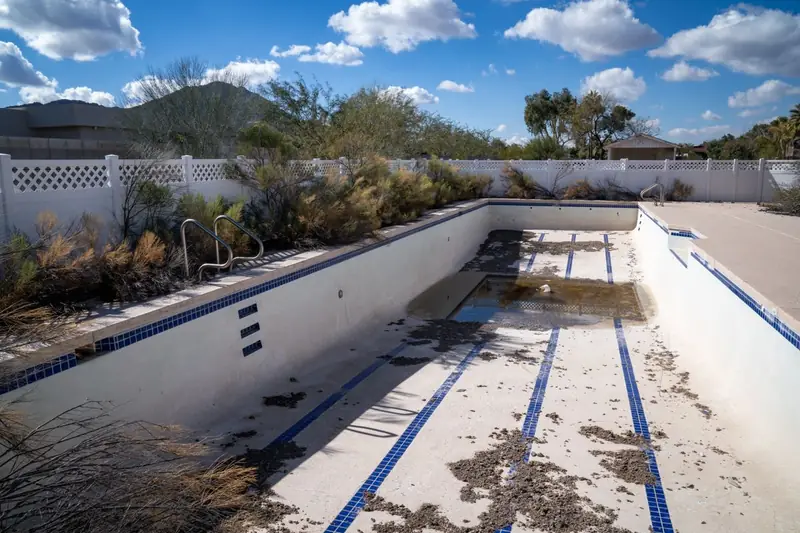
When full removal is the better choice
- You plan to build over the area — an addition, casita, garage, or slab
- You want the cleanest story for a future buyer or appraiser
- You want normal planting and irrigation everywhere, without a buried shell
For building over the old pool, Glendale requires a certified compaction report from a soil engineer. Maricopa County’s rules for unincorporated areas go further: when a building or structure is planned over or within 5 feet of the pool, backfill is placed under a geotechnical engineer’s supervision to at least 90% relative compaction, with a compaction report approved before final.
Source: City of Glendale — Swimming Pool Demolition requirements (PDF); Maricopa County — Pool and Spa Demolition DD-5015-01, retrieved 2026-11-17.
What a full removal usually involves
Permit and locates
Pull the city demolition permit, then request Arizona 811 locates at least two full working days before digging.
Drain the pool the legal way
In Glendale, through the home’s sewer cleanout at 12 gallons per minute or less, never into the street.
Disconnect equipment and utilities
Remove the pump, filter, heater, and above-ground plumbing. Glendale requires removing sub-feed conductors back to the electric service if the pool sub-panel comes out.
Break out and haul the shell
Demolish the gunite or concrete shell and steel, and haul debris away instead of burying it.
Backfill and compact in layers
Clean fill placed and compacted in lifts; testing and a soil engineer’s report where you will build.
Final inspection and finish grade
Close the permit, then grade for drainage and finish with pavers, granite, or landscaping.
Source: Arizona 811 — Homeowners; City of Glendale — How to Drain and Backwash Pools Legally (PDF); City of Glendale — Swimming Pool Demolition requirements (PDF), retrieved 2026-11-17.
What moves the scope (not a price)
- Pool size, depth, and shell type — and any attached spa, raised wall, or water feature
- Access — a wide side gate is very different from a block wall that has to be opened and rebuilt
- Decking — whether the surrounding concrete deck comes out too
- Engineering — compaction testing and a soil engineer’s report if you will build there
- Utilities — gas to a pool heater, electrical sub-panel and conductors, and irrigation crossing the area
- What goes back — pavers, decomposed granite, turf-free landscaping, or a slab
Send photos of the pool and the side yard and we will quote full and partial options side by side.
Request a quoteFull removal FAQ
How long does a full pool removal take?
It depends on size, access, and inspection scheduling. Full removal takes longer than partial removal because the whole shell is hauled away and the fill is compacted in layers.
Does full removal still qualify for the Glendale rebate?
The city’s rebate is for removing an in-ground pool or spa under a demolition permit, with an acceptable replacement surface. It does not require one method over the other. Check the current rules on the city’s rebate page before you start.
Is a dust permit needed?
Maricopa County requires a dust control permit for projects that disturb 0.10 acre (4,356 square feet) or more. Many single-pool jobs fall under that, but a large pool plus deck and staging area can add up.
Source: City of Glendale — Water Conservation Rebates; Maricopa County Air Quality — Dust and Miscellaneous Portal, retrieved 2026-11-17.